Who are the people behind the future of statistics and data science?
What do Alzheimer’s disease research, training neural networks on corrupted data, reconstructing geometric shapes, and the mathematical foundations of artificial intelligence have in common? We sat down with four students from the Department of Statistics at the University of Haifa, each coming from a different starting point—and all finding themselves at the forefront of unanswered questions.
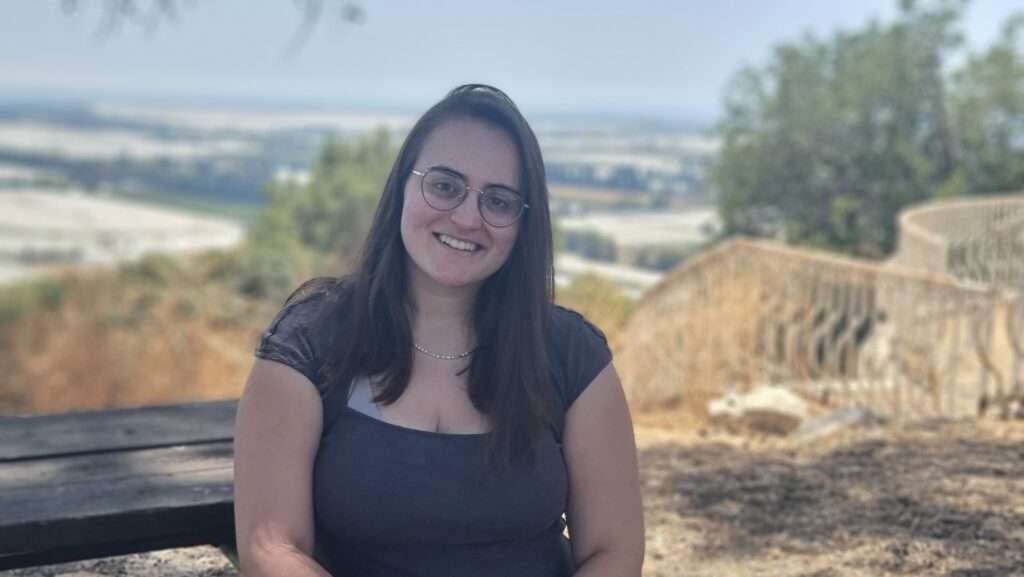
Dror Arviv: Teaching a Machine to Handle Our Mistakes
Dror Arviv is a student in the International M.Sc. Program in Statistics, an alumna of the department, and alongside her studies works as a researcher at “Noga – Israel Independent System Operator.” Her research asks a highly practical question: what happens when you train an artificial intelligence model on data containing errors?
“The massive models transforming the world today, like ChatGPT, rely on enormous amounts of data that will never be 100% clean,” she explains. Dror is therefore working to pinpoint the window of time in which a model absorbs genuine information—before it begins memorizing the noise. This phenomenon is known as “early learning,” and it may hold the key to training more accurate models without an unlimited budget for producing clean data.
“I was looking for a field that bridges classical statistical theory with the cutting edge of artificial intelligence technology,” she says. “To truly understand why these models work the way they do.”
Dror ArvivYunlong Peng: From Medicine to the Mathematical Foundations of AI
Yunlong Peng arrived at statistics via an unconventional path—with no prior background in mathematics or statistics. Today, he is completing his M.Sc., works as a teaching assistant in advanced courses, and plans to pursue a Ph.D. in the department.
In the meantime, he is keeping busy: two research projects with Clalit Health Services focus on Alzheimer’s disease and schizophrenia, examining how different treatment strategies affect disease progression using machine learning methods. Yet his Ph.D. will take him in an entirely different direction: the mathematical foundations of neural networks and large language models.
“For me, statistics is about learning from data to uncover the truth, or at least get closer to it,” he says. “Even if my contribution to data science remains small—behind the day-to-day research process lies a pursuit of truth and genuine care for human destiny.”
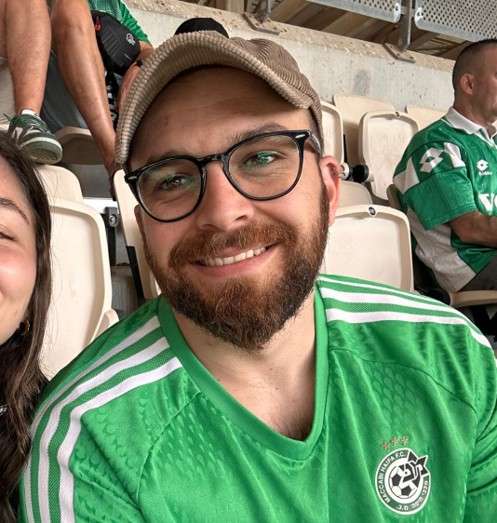
Yunlong PengAntonio Sorcel: When Data Is “Contaminated,” Conclusions Break Down Too
Antonio Sorcel completed his B.Sc. in Statistics and is now pursuing an M.Sc. with a specialization in Data Science, supervised by Dr. Bella Vakulenko-Lagun. His thesis addresses a question at the very heart of every medical study’s credibility: how do you analyze data drawn from healthcare medical records that were not originally created for research, and are therefore incomplete and full of gaps?
Beyond his thesis, he is taking part in an international study with leading universities in the US and the UK, searching for an effective treatment for Alzheimer’s disease through “drug repurposing.” The goal: enabling clinical researchers to conduct retrospective clinical trials without meeting a single patient—solely through big data analysis.
“We all know how rapidly AI is exploding across the world right now,” he says, “but if we feed biased data into models, we will get flawed conclusions. That is why the field of improving data quality will only continue to grow.”
Antonio SorcelAmit Donner: Geometry, Noise, and Accurate Estimation
Amit Donner is a Ph.D. candidate and lecturer in the department, pursuing his doctorate under the supervision of Prof. Alexander Goldenshluger. He completed his entire academic journey in the department—B.Sc., M.Sc., and now his third year of Ph.D. studies. His research is a direct continuation of his M.Sc. thesis: reconstructing geometric shapes from noisy observations under measurement errors.
It may sound theoretical—and it involves plenty of mathematics—but its implications reach computer vision, physics, and other fields where data is never completely exact.
“This field requires mastering many subjects: probability, statistical, and mathematical theory, as well as applied skills in optimization and numerical analysis,” he explains. “The growing recognition that data is not always accurate—and that this isn’t standard random noise—is what makes this topic so relevant today.”
Looking toward the future, Amit is optimistic: “The abundance of data and the need to extract insights from it will only increase the demand for statistics. It is the primary tool for validating empirical results—and that is not going to change anytime soon.”
Amit DonnerFour young researchers, four distinct fields—and one common denominator: all believe that the path to understanding the world runs through the data it leaves behind. Even when it is noisy, incomplete, or full of errors. Want to be the next researcher who finds order within the chaos? The Department of Statistics at the University of Haifa is waiting for you. Click here for more details.
אתר זה עושה שימוש שימוש בקבצי עוגיות (COOKIES) וטכנולוגיות מעקב לצורך תפעולו התקין ואבטחתו וגם למטרות נוספות כמו שיפור חווית הגלישה, ניתוח נתונים סטטיסטיים פרסום מותאם אישית או מבוסס העדפות. אנו לא נתקין באמצעות האתר על מכשירך עוגיות וטכנולוגיות מעקב נוספות שאינן הכרחיים לתפעול הטכני של האתר ללא הסכמתך. למידע נוסף אנא עיין בחלק "נתונים שאינם מידע אישי אשר אנו אוספים באתר" במדיניות הפרטיות שלנו.
"This website uses cookies and tracking technologies for its proper functioning and security, as well as for additional purposes such as improving your browsing experience, statistical data analysis, and personalized or preference-based advertising. We will not install on your device any cookies or tracking technologies that are not strictly necessary for the technical operation of the site without your consent. For more information, please refer to the section “Non-Personal Data we Collect" in our privacy policy